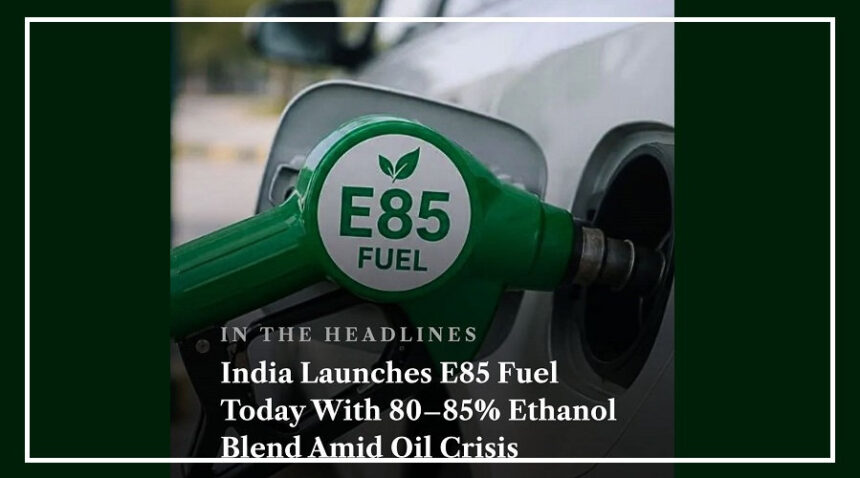
India has taken another step towards cleaner and more affordable fuel options with the launch of E85 fuel in Delhi.
Priced at ₹82.12 per litre, the new fuel is ₹20 cheaper than regular E20 petrol, making it an attractive option for eligible vehicle owners.
The launch is part of the government’s broader plan to reduce crude oil imports, promote cleaner transportation, and increase the use of domestically produced biofuels.
Delhi Gets Its First E85 Fuel Station
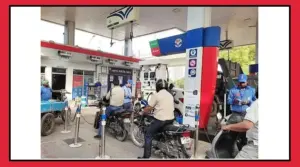
Union Petroleum and Natural Gas Minister Hardeep Singh Puri inaugurated Delhi’s first E85 fuel dispensing station at Indian Oil’s Pusa Road outlet on World Environment Day.
With this launch, vehicle owners with compatible vehicles can now start purchasing E85 fuel in the national capital.
At present, E85 is priced at ₹82.12 per litre, while regular E20 petrol costs around ₹102.12 per litre in Delhi.
This creates a direct saving of ₹20 per litre at the fuel station.
What Is E85 Fuel?
E85 is a fuel blend made up of:
85% ethanol
15% petrol
The fuel is specially designed for Flex Fuel Vehicles (FFVs), which can run on higher ethanol blends without requiring engine modifications.
The government believes that wider adoption of E85 can help reduce pollution, cut dependence on imported crude oil, and support ethanol production from crops such as sugarcane.
Why Is E85 Cheaper?
The government has intentionally kept E85 cheaper than petrol to encourage its use.
The ₹20-per-litre price difference is meant to make the fuel more attractive to consumers and support the country’s ethanol-blending programme.
However, the lower price does not necessarily mean lower overall running costs.
The Biggest Drawback: Lower Mileage
While E85 costs less at the pump, ethanol contains less energy than petrol.
As a result, vehicles running on E85 are likely to consume more fuel to cover the same distance.
According to industry estimates, E85-compatible vehicles may use 25% to 35% more fuel compared to vehicles running on E20 petrol.
This means that although the fuel is cheaper, some of the savings may be offset by lower fuel efficiency.
Another factor to consider is that flex-fuel vehicles generally cost more than regular petrol vehicles.
Who Can Use E85 Fuel?
Not all petrol vehicles can run on E85.
The fuel is currently meant only for Flex Fuel Vehicles that are specifically designed to handle ethanol concentrations of up to 85%.
Using E85 in a vehicle that is not approved for it could lead to performance or engine-related issues.
Government Plans Major Expansion
The rollout of E85 fuel is only beginning.
The government plans to introduce E85 at 50 to 100 fuel stations across Delhi-NCR, Mumbai, Pune, and Nagpur in the initial phase.
By the end of 2026, the network is expected to expand to around 500 fuel stations.
The target is to reach nearly 5,000 E85 dispensing stations across major cities by the end of 2027.
What Does This Mean for Consumers?
The launch of E85 fuel marks an important step in India’s push for cleaner and more sustainable energy.
For owners of flex-fuel vehicles, the lower fuel price could help reduce fuel expenses.
At the same time, increased ethanol use can support India’s efforts to reduce oil imports and lower vehicle emissions.

However, consumers should also keep in mind that E85 delivers lower mileage than petrol, making real-world savings dependent on driving patterns and vehicle efficiency.
As more flex-fuel vehicles enter the market and fuel stations expand across the country, E85 could become a significant part of India’s future fuel ecosystem.