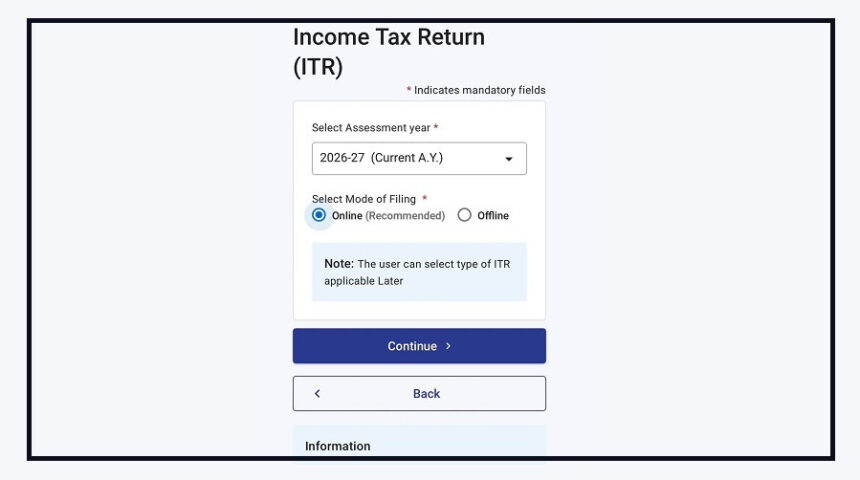
The Income Tax Department has officially started the income tax return filing process for Assessment Year (AY) 2026-27, related to Financial Year (FY) 2025-26.
Taxpayers can now begin filing their returns after the department released the Excel utilities for ITR-1 and ITR-4 on the e-Filing portal.
The Income Tax Department also confirmed the update through an official announcement on X.
Big Relief for Taxpayers With Two Houses
One of the biggest changes this year is in the ITR-1 (Sahaj) form.
Earlier, taxpayers could report income from only one house property under ITR-1.
Now, taxpayers can include income from up to two house properties in the same form.
This change is expected to make return filing easier for many salaried individuals and small taxpayers.
Who Can File ITR-1 (Sahaj)?
ITR-1 is meant for resident individuals with a total annual income of up to ₹50 lakh.
People with the following income sources can use this form:
Salary or pension income
Income from up to two house properties
Interest income and other sources
Long-term capital gains under Section 112A up to ₹1.25 lakh
Agricultural income up to ₹5,000
However, some taxpayers are not eligible to use ITR-1.
Who Cannot Use ITR-1?
You cannot file ITR-1 if:
You are a company director
You have invested in unlisted shares
You have foreign assets or financial interests abroad
TDS has been deducted under Section 194N
Tax on ESOPs has been deferred
Such taxpayers will need to use other ITR forms.
Major Income Tax Changes Coming From April 2026
The income tax system is also set for a major update from April 1, 2026.
The new Income Tax Act, 2025 will replace the old Income Tax Act of 1961, bringing several changes in tax rules, terminology, and compliance procedures.
One major change will be the replacement of:
Financial Year (FY)
Assessment Year (AY)
These will now be merged into a single “Tax Year” system to make tax filing simpler and easier to understand.
Income Tax Return Deadlines Also Revised
The deadline for salaried individuals to file ITR will remain July 31.
However, self-employed individuals, professionals, and non-audit taxpayers will now get extra time and can file returns till August 31.

The revised timelines are expected to provide more flexibility to taxpayers while filing returns.