

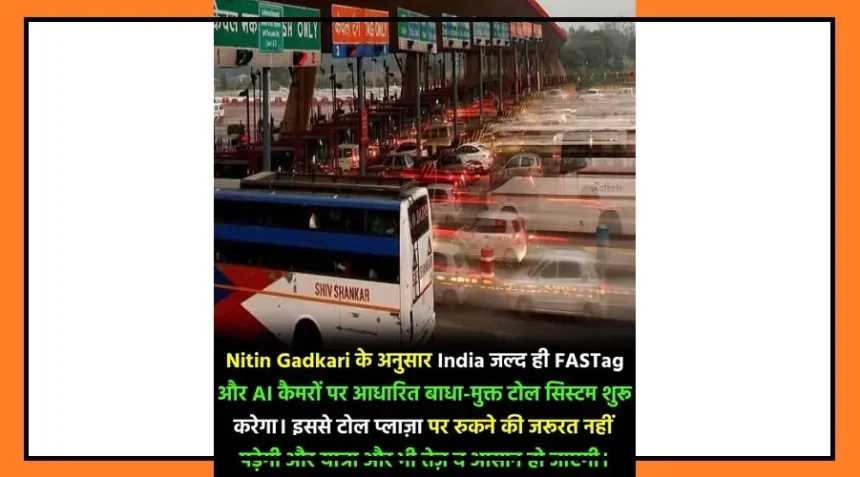
Long queues at toll plazas could soon become a thing of the past. The National Highways Authority of India (NHAI) has introduced the country’s first barrier-free tolling system in Surat, Gujarat.
This new technology aims to make highway travel faster, smoother, and more convenient for everyone.
At the Choryasi toll plaza on NH-48, vehicles no longer need to stop. Instead, they can pass through freely while the toll is deducted automatically. This move is expected to reduce traffic congestion and save valuable time for commuters.
What is the MLFF System?
The Multi-Lane Free Flow (MLFF) system is a modern toll collection method where there are no physical barriers. Unlike traditional toll plazas, vehicles don’t have to slow down or stop.
With the help of advanced sensors and cameras, the system identifies vehicles as they pass through. The toll amount is then deducted instantly, making the entire process seamless and hassle-free.
No More Long Lines or Traffic Jams
Earlier, even with FASTag, vehicles had to stop briefly at toll booths for scanning. This often led to long queues, especially during peak hours.
Now, with the MLFF system, vehicles can pass at speeds of up to 80–100 kmph without stopping. This change is expected to almost eliminate traffic jams at toll plazas.
Another major benefit is fuel savings. Since vehicles no longer need to stop and start repeatedly, it reduces fuel consumption and ensures a smoother driving experience.
How Does This Technology Work?
The system uses high-tech cameras and sensors installed on overhead structures called gantries. As a vehicle passes underneath:
FASTag is scanned automatically
If FASTag is not available, cameras read the number plate using ANPR (Automatic Number Plate Recognition)
The toll is deducted directly, or a challan is issued if needed
This ensures that every vehicle is accounted for without interrupting traffic flow.
A Big Step for India’s Highway Future
This project is seen as a major milestone for India’s road infrastructure. It shows how technology can make travel faster and more efficient.
NHAI plans to expand this system to other busy highways, including major routes like the Delhi-Mumbai Expressway. The long-term goal is to remove physical toll booths completely and shift to advanced systems like GPS-based tolling.
What Officials Are Saying
Amit Ranjan Chitranshi, Chief Operating Officer of NHAI, confirmed that vehicles will not need to stop under this system.
He also clarified that while the method of toll collection has changed, the existing rules remain the same under the National Highway Fee Rules, 2008.
He added that this is an upgraded version of current technology and will soon be implemented across more highways in India, especially those with four or more lanes.