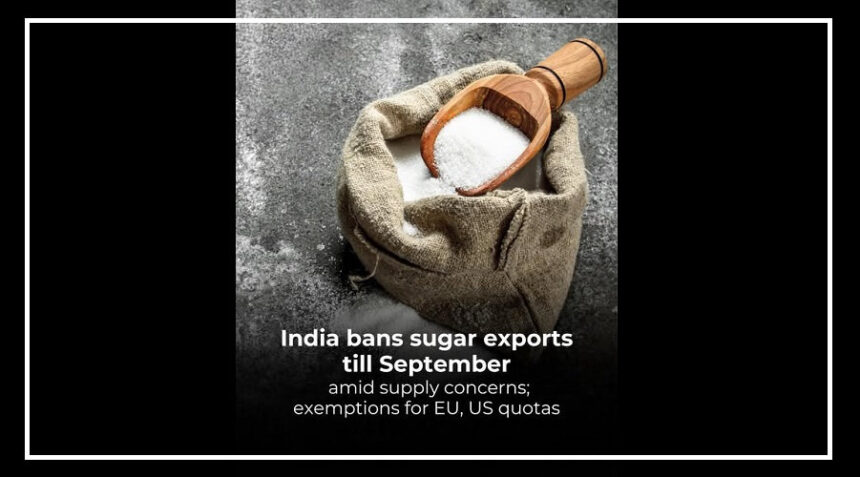
India is expected to continue restrictions on sugar exports until at least September 2026 as the government focuses on keeping domestic supply stable and controlling food inflation.
The decision comes at a time when global sugar prices remain volatile and concerns over sugar availability are growing inside the country.
As the world’s second-largest sugar producer after Brazil, India’s export decisions have a major impact on global sugar markets.
Why India Is Limiting Sugar Exports
The government’s biggest concern right now is domestic supply.
Several factors are putting pressure on sugar production:
Lower sugarcane yields in some states
Rising temperatures and irregular rainfall
Growing use of sugarcane for ethanol production
India has been aggressively pushing its ethanol blending programme to reduce crude oil imports and improve energy security.
Because of this, sugar mills are increasingly diverting sugarcane and molasses toward ethanol production instead of making sugar.
The government is aiming for:
20% ethanol blending in petrol
Lower fuel import dependence
Reduced carbon emissions
While the strategy supports clean energy goals, it also reduces the amount of sugar available in the market.
Food Inflation Is Another Big Concern
The government also wants to prevent a sharp rise in sugar prices ahead of the festive season.
Officials are trying to avoid:
Sudden price spikes
Higher food inflation
Supply shortages
Increased costs for food and beverage companies
Sugar is considered a sensitive commodity in India because it directly affects everyday household spending.
It impacts:
Tea and sweets
Bakery products
Cold drinks and beverages
Restaurants and confectionery businesses
Reports suggest retail sugar prices have already started showing upward pressure in several markets.
India’s Sugar Exports Have Dropped Sharply
The export restrictions have almost completely reduced India’s sugar shipments to global markets.
India exported:

Around 11 million tonnes in 2021-22
About 6 million tonnes in 2022-23
Almost no sugar under the current restrictions
The decline has affected:
Sugar exporters
Commodity traders
Port logistics companies
Global buyers dependent on Indian sugar
Many countries are now turning to Brazil and Thailand to meet their sugar needs.
Global Sugar Prices Could Stay High
India plays a very important role in the global sugar trade.
When India limits exports, global supply tightens quickly.
Experts believe the restrictions could lead to:
Higher global sugar prices
Greater market share for Brazil
Increased import costs for Asian and African countries
India’s sugar policy is closely watched worldwide because the country can rapidly shift between being a major exporter and focusing only on domestic demand.
Sugar Companies Face Both Risks and Benefits
For Indian sugar mills, the situation is mixed.
Challenges include:
Lower export earnings
Fewer international sales opportunities
Inventory management pressure
But there are also advantages:
Strong growth in ethanol revenues
Better domestic sugar prices
Continued government support for biofuel production
Many sugar companies are now becoming integrated energy businesses through large-scale ethanol production.
The Bigger Picture Behind the Decision
The sugar export restriction reflects a larger trend in India’s economic strategy.
In recent years, the government has increasingly focused on protecting domestic supply in essential commodities.
India has already:
Restricted wheat exports
Limited rice shipments
Controlled onion exports
Closely monitored edible oil and pulses supply
Now sugar has become part of that broader strategy.
The larger concern is that climate change, energy transition, and global uncertainty are making food security and fuel security more connected than ever before.
For consumers, though, the immediate impact is simple:
If supply pressure continues and demand stays strong, sugar prices may remain high during the festive season and possibly beyond.