The Ministry of Railways is taking major steps to improve freight transportation, strengthen regional connectivity, and provide efficient first- and last-mile delivery solutions.
Key initiatives include the launch of a pilot app-based logistics platform called “Rail Parcel,” expansion of the Joint Parcel Product–Rapid Cargo Service (JPP-RCS), and significant investment in freight terminal infrastructure.
Upgrading Freight Terminals and Infrastructure
Indian Railways is following a two-part strategy to improve freight handling:
Modern Freight Terminals: Developed under the Gati Shakti Multi-Modal Cargo Terminal (GCT) policy, 128 terminals are already operational, and approvals have been granted for 288 more.
Railway-Owned Goods Sheds: Infrastructure is being upgraded to enhance efficiency and customer amenities, with ₹14,500 crore allocated between 2023-24 and 2025-26.
These measures aim to make freight transport faster, more reliable, and convenient for businesses and customers alike.
Expansion of Joint Parcel Product – Rapid Cargo Service
The Joint Parcel Product was launched in 2022 as a pilot in partnership with India Post to support B2C and B2B logistics, especially for e-commerce companies and MSMEs, handling shipments between 35 kg and 100 kg.
India Post manages first- and last-mile delivery, while Indian Railways handles mid-distance transportation.
The service has now been expanded and renamed JPP-RCS, allowing parcel aggregators to book online via the Virtual Aggregation Platform.
Currently, seven pairs of scheduled cargo services are running, generating around ₹56 crore in revenue this financial year.
CONCOR offers door-to-door services on Delhi–Kolkata and Mumbai–Kolkata routes, with similar pilot services tested at the Sonik Goods Shed.
Rail Parcel App: A Digital Marketplace for Logistics
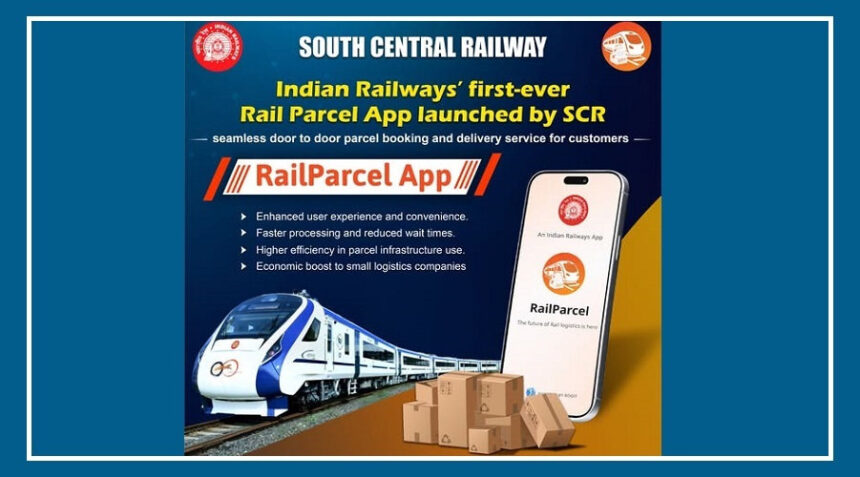
The “Rail Parcel” app, launched on February 25 as a one-year pilot, acts as a digital marketplace connecting Indian Railways with logistics partners.
Logistics providers handle parcel pickup, packaging, and last-mile delivery, while Indian Railways manages main transportation.
The pilot is running at 17 railway stations across seven cities, including Hyderabad, Visakhapatnam, Vijayawada, Guntur, Rajahmundry, Bengaluru, and Chennai.
Three private logistics companies have been onboarded so far.
In addition, Business Development Units across all railway divisions are working to assess freight demand and identify logistics providers for efficient first- and last-mile services.
This approach positions Indian Railways as a modern, technology-driven logistics provider, improving efficiency for businesses and customers across the country.