
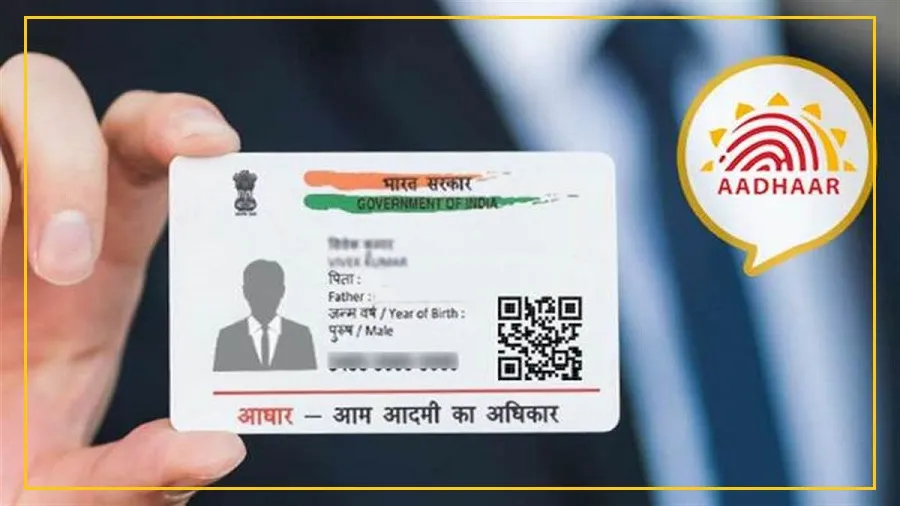
Big changes may soon be introduced in Aadhaar rules, directly affecting crores of children and their parents.
UIDAI is considering making the birth certificate mandatory for Aadhaar enrolment for all children up to 18 years of age.
At present, a birth certificate is compulsory only for children aged 0 to 5 years.
If the new proposal is approved, the birth certificate will become the only valid document for Aadhaar enrolment for minors.
The move aims to tighten identity verification and reduce fraud.
UIDAI Receives 75,000 Aadhaar Applications Daily
UIDAI CEO Bhuvnesh Kumar shared these details during a workshop held in Raipur.
He revealed that UIDAI receives around 75,000 Aadhaar enrolment applications every day.
About 98 percent of these applications come from children below 18 years. Children aged 0–5 years and 5–18 years contribute almost equally, around 49 percent each.
In comparison, applications from adults above 18 years are only about 1,600 per day, roughly 2 percent of the total.
Birth Certificate to Decide Name Changes for Children
UIDAI is also planning to make birth certificates mandatory for changing a child’s name in Aadhaar.
Many parents request name changes without proper documents.
Under the new system, only the name mentioned on the birth certificate will be considered valid.
Even for name correction or change, the birth certificate will be required.
This step is meant to bring clarity and prevent misuse.
Address and Mobile Number Updates Top Requests
According to UIDAI, most Aadhaar update requests are related to address and mobile number changes.
People often move cities or change phone numbers, leading to frequent update requests.
Apart from this, thousands of applications for name and date-of-birth changes are also received daily.
In total, UIDAI handles nearly 23 crore update requests every year, which works out to around 7.5 lakh requests per day.
Strict Limits on Name and Date of Birth Changes
To curb fraud, UIDAI has tightened its rules.
Date of birth can now be changed only once, while name changes are allowed only twice.
For major name changes, a Gazette notification has been made compulsory.
UIDAI is also using artificial intelligence and machine learning to strengthen biometric checks and ensure that no person gets more than one Aadhaar number.
Shift Towards Online Verification and New Technology
UIDAI is gradually moving away from offline document checks and focusing more on online verification.
Documents like birth certificates, CBSE mark sheets, PAN, passport, MGNREGA, and PDS records are being linked with government databases.
Birth certificate systems from 35 states are already integrated with UIDAI, allowing instant verification.
A new universal client software is also being introduced and is expected to be installed on all enrolment machines by October.
This will allow QR-based documents to be scanned and verified instantly.
Aadhaar’s Role in Public Welfare and Security
UIDAI officials highlighted that before Aadhaar, nearly 25 crore people in India had no identity proof.
Aadhaar gave them an official identity and helped them access government schemes.
Through Direct Benefit Transfer, the government has saved nearly 40 times more than the total cost of implementing Aadhaar.

UIDAI currently performs about 90 million authentications daily using OTP, biometrics, and face authentication.
Face authentication is being promoted as a secure and convenient option.
UIDAI has made it clear that while stricter rules may seem inconvenient, they are necessary to maintain trust, prevent fraud, and make Aadhaar more secure and transparent in the future.