Most people know about personal PAN cards, but very few families take advantage of the tax benefits offered by an HUF PAN card.
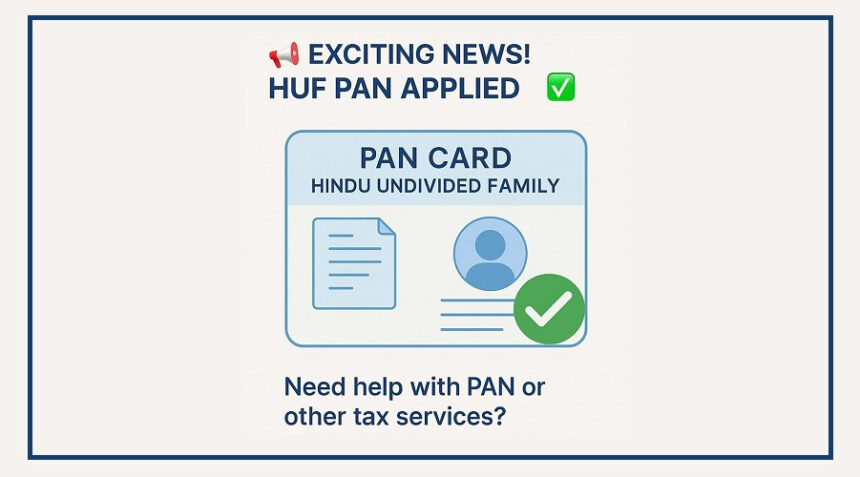
An HUF, or Hindu Undivided Family, is treated as a separate legal and tax-paying entity under Indian law.
It gets its own PAN card and files a separate Income Tax Return (ITR), apart from individual family members.
For many families, this can become a useful way to manage ancestral property, family business income, investments, and taxes more efficiently.
Who Can Create an HUF?
Under Indian law, Hindu, Sikh, Buddhist, and Jain families can form an HUF.
An HUF usually includes:
A common ancestor
Children and grandchildren
Their spouses
Unmarried daughters
The family operates together as one financial unit, and the eldest member generally acts as the “Karta,” who manages all HUF-related financial activities.
Major Tax Benefits of an HUF PAN Card
One of the biggest reasons families create an HUF is to legally reduce their overall tax burden.
Separate Tax Exemption Limit
Since the HUF is considered a separate taxpayer, it gets its own basic tax exemption limit of ₹2.5 lakh under the old tax regime for Assessment Year 2026-27.
This exemption is completely separate from the limits available to individual family members.
Income Splitting Can Reduce Tax
Income from ancestral property, rent, family business, or investments can be transferred to the HUF account.
This helps split income between individuals and the HUF, which may reduce the overall tax liability by keeping income under lower tax slabs.
Extra Deductions Under Section 80C
The HUF can also claim tax deductions of up to ₹1.5 lakh under Section 80C.
These deductions can be claimed through:
PPF investments
ELSS funds
5-year fixed deposits
Life insurance premiums
Health Insurance Tax Benefit
Under Section 80D, the HUF can claim:
Up to ₹25,000 for health insurance premiums
Up to ₹50,000 if senior citizens are covered
Other Financial Advantages of an HUF
Tax Savings on Rental Income
If family-owned property is rented through the HUF, the rental income gets taxed in the HUF’s name instead of an individual’s name.
This can help save tax, especially if individual members already fall into higher income tax slabs.
Home Loan Interest Deduction
If the HUF purchases a house using a home loan, it can claim up to ₹2 lakh deduction on home loan interest under Section 24B.
Tax-Free Gifts and Capital Gains Relief
Gifts received from family members are generally tax-free for the HUF.
The HUF can also save capital gains tax by reinvesting in residential property under Section 54F.

How to Apply for an HUF PAN Card
Applying for an HUF PAN card is a simple process if the documents are ready.
Step 1: Prepare an HUF Deed
The Karta must prepare a written declaration on stamp paper mentioning all family members involved in the HUF.
Step 2: Fill Form 49A
Apply online through:
Protean eGov Technologies (formerly NSDL)
UTI Infrastructure Technology and Services Limited
While filling the form, select “Hindu Undivided Family” as the applicant type.
Step 3: Submit Required Documents
You will need:
Affidavit from the Karta
Identity proof of the Karta
Address proof of the Karta
Step 4: Verification and PAN Issuance
After submitting the form, documents are verified by the department. Once approved, a separate HUF PAN card is issued.
Important Rules Families Should Know
Before creating an HUF, families should understand some important tax rules.
Same Deduction Cannot Be Claimed Twice
If the HUF claims a deduction under Section 80C, the same expense cannot be claimed again by an individual family member.
Clubbing Rules May Apply
If someone transfers assets to the HUF without proper payment, the income generated from those assets may sometimes be added back to that person’s taxable income.
Karta Handles Financial Decisions
The Karta is responsible for:
Managing bank accounts
Filing taxes
Handling investments
Taking financial decisions for the HUF
For families with shared property or investments, an HUF can become a useful tool for better tax planning and financial management.