

In today’s digital era, many daily activities such as bill payments and mobile recharges are done online. However, cash is still needed for small expenses.
Many people face a common problem when they go to the market with a ₹100 or ₹500 note. Shopkeepers often say they do not have change.
Because online payments have become very common, small currency notes are often hard to find in the market. These notes are important for paying auto-rickshaw fares or buying small items.
Even though people feel there is a shortage of small notes, the government says that there is no shortage of such notes in circulation. At the same time, there are plans to make small notes available through ATMs as well.
Government’s Plan for Small Notes in ATMs
Last Tuesday, the central government informed Parliament that India has enough small denomination notes.

While answering a question, Pankaj Chaudhary, Minister of State for Finance, said that ₹10, ₹20, and ₹50 notes are already circulating in sufficient numbers.
However, when people withdraw money from ATMs, they usually receive ₹500 notes. Sometimes ₹100 or ₹200 notes are also dispensed, but smaller notes are rarely available.
Because of this, people often face difficulty in getting change for a ₹500 note.

To solve this problem, Pankaj Chaudhary explained that many older ATMs were not designed to give small denomination notes.
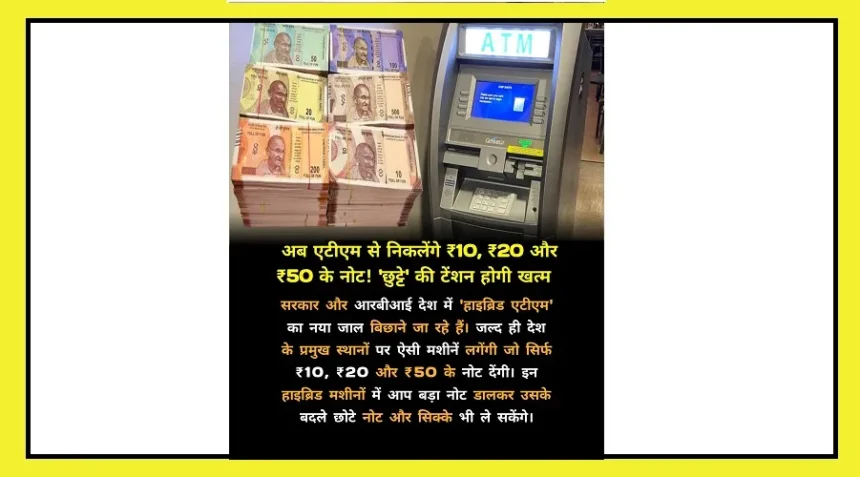
To address this issue, the government has started a pilot project. Under this project, special “small denomination dispensers” are being tested.
These machines will allow people to withdraw ₹10, ₹20, and ₹50 notes directly from ATMs, making it easier to get change when withdrawing cash.
Supply of Small Notes in the Market
The government also shared data about the supply of smaller currency notes. According to the data, in the current financial year (as of February 26), the Reserve Bank of India supplied:
₹439.4 crore worth of ₹10 notes
₹193.7 crore worth of ₹20 notes

₹130.3 crore worth of ₹50 notes
In the previous financial year 2025, the supply included:
₹180 crore worth of ₹10 notes
₹150 crore worth of ₹20 notes
₹300 crore worth of ₹50 notes
The Reserve Bank of India regularly reviews the demand for different currency denominations and decides how many notes need to be printed.
According to the government, the demand for low-value cash is met through both banknotes and coins.
At the same time, digital payments are now widely used, even for small transactions, which has reduced the overall dependence on small cash payments.