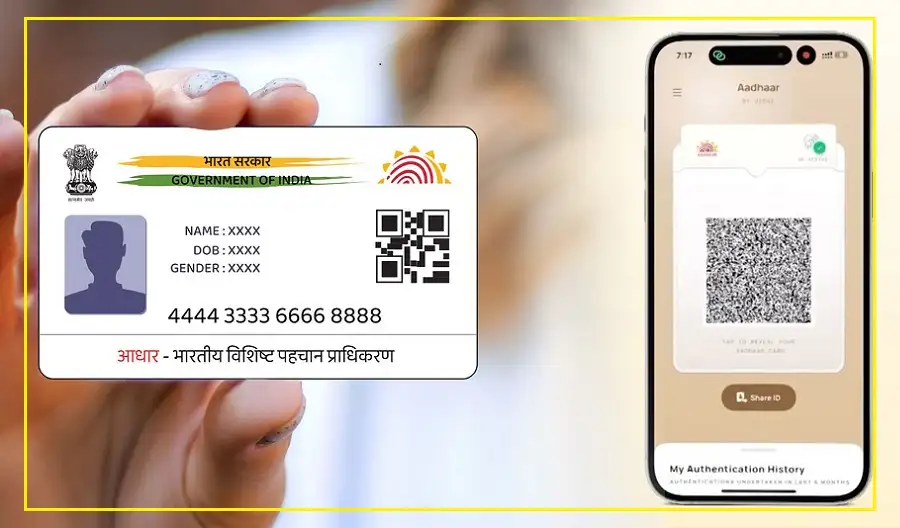
The central government has notified new Aadhaar rules that officially allow face authentication while making consent and data use rules stricter.
These changes align with the Digital Personal Data Protection (DPDP) Act and mark an important shift in how Aadhaar can be used outside government services.
The updated rules also clarify how private companies can legally use Aadhaar, bringing more transparency and stronger privacy safeguards for users.
Aadhaar Use Set to Expand Beyond Government Services
The new rules come at a time when UIDAI is preparing to launch a redesigned Aadhaar app.
According to officials, this app will make Aadhaar-based identity checks possible for daily activities such as hotel check-ins, event entry, deliveries, and access to gated premises.
A key change is that many of these verifications may work without continuous connection to UIDAI’s central database, making the process faster and more privacy-friendly.
What Exactly Has Changed in the Aadhaar Rules?
For the first time, face authentication has received full legal recognition as a valid Aadhaar verification method.
It now stands alongside fingerprints, iris scans, and OTP-based authentication.
The rules also strengthen offline Aadhaar verification.
This means users can verify their identity without real-time access to UIDAI servers by sharing digitally signed details through QR codes or secure apps.
This allows Aadhaar holders to confirm their identity while keeping better control over their personal data.
Why Face Authentication Matters
Face authentication is especially useful in situations where fingerprint or iris scans are difficult or impractical.
It is also helpful for organisations that do not want to become full Aadhaar Authentication User Agencies.
UIDAI officials say facial verification done on the user’s device acts as a “proof of presence.”
It confirms that the Aadhaar holder is physically present without sending biometric data to UIDAI servers.
This opens the door for smoother identity checks at public events, residential complexes, and ticketed venues, similar to DigiYatra-style systems used at airports.
Stronger Privacy and Consent Controls
The new rules clearly state that Aadhaar usage must follow three key principles:
Use only for a specific purpose
Based on clear and informed user consent
Limited to the minimum data required
These principles reflect the DPDP Act, which aims to prevent unnecessary data collection and misuse.
Under the updated system, users can choose what information to share.
For example, they may only share age or a photograph instead of their full Aadhaar details.
Clearing the Grey Area for Private Aadhaar Use
The rules also address long-standing concerns about how some private companies were accessing Aadhaar data.
UIDAI has earlier pointed out that asking users to fetch Aadhaar details via OTP-based portals is illegal.
By formally allowing offline verification, the government is closing these loopholes and offering a lawful alternative that protects user privacy.
How the New Aadhaar App Fits In
UIDAI officials say the upcoming Aadhaar app is designed to support these changes.
The app will store Aadhaar credentials securely on the user’s device and allow selective data sharing through QR codes.
It will also support offline face-based verification, giving users more control while making Aadhaar safer and easier to use in everyday situations.
Overall, the new rules aim to balance wider Aadhaar usage with stronger privacy protection, making identity verification simpler, safer, and more transparent for users.