

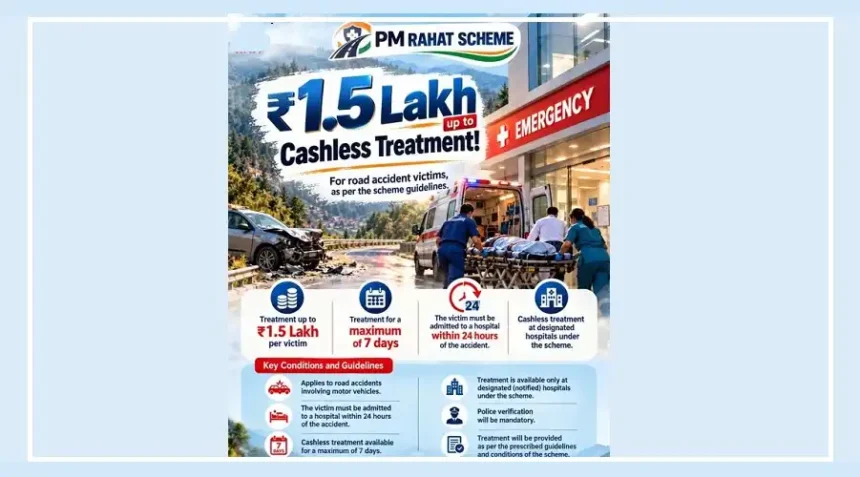
PM RAHAT Scheme provides road accident victims with cashless medical treatment of up to ₹1.5 lakh for a maximum of seven days, helping injured people receive emergency care without worrying about immediate hospital expenses.
The initiative is designed to ensure that financial difficulties do not delay life-saving treatment after a road accident.
The scheme was recently discussed at a state-level workshop organised in Patna, Bihar, on November 4, 2026.
Police officials and representatives of Ayushman Bharat hospitals received training on its implementation, including emergency response through Dial-112, hospital registration, police verification and the TMS 2.0 portal.
The workshop focused on improving coordination between the transport, health and police departments so that accident victims can receive timely medical assistance.
PM RAHAT Scheme: What Is It and Who Can Benefit?
PM-RAHAT stands for Prime Minister – Road Accident Victims’ Hospitalisation and Assured Treatment.
It is a central government initiative aimed at providing immediate cashless medical assistance to people injured in road accidents involving motor vehicles.
Unlike health insurance schemes that cover only identified beneficiaries, PM-RAHAT is designed to cover eligible road accident victims irrespective of their economic background.
Under the scheme, eligible victims can receive cashless treatment worth up to ₹1.5 lakh per person for a maximum period of seven days from the date of the accident.
The benefit applies to qualifying motor vehicle accidents on any category of road across India.
Victims who require hospitalisation because of accident-related injuries can access treatment at designated hospitals, subject to the scheme’s eligibility conditions.
The scheme is particularly important for people who may not have health insurance or sufficient money to pay hospital bills immediately after an accident.
How Much Cashless Treatment Is Available?
The government has fixed a maximum treatment limit of ₹1.5 lakh per eligible road accident victim. The treatment expenses are covered for up to seven days from the date of the accident.
The scheme also provides for emergency stabilisation treatment.
Victims with non-life-threatening injuries can receive stabilisation treatment for up to 24 hours, while those with life-threatening injuries can receive it for up to 48 hours at designated hospitals, subject to the prescribed conditions and police response.
The objective is to ensure that medical treatment begins immediately rather than being delayed because of payment formalities.
The scheme operates through designated hospitals, including eligible hospitals empanelled under Ayushman Bharat Pradhan Mantri Jan Arogya Yojana (AB-PMJAY).
It is important to understand that the ₹1.5 lakh limit is the maximum cashless treatment coverage, not a direct cash payment to the accident victim.
How to Get Cashless Treatment Under PM RAHAT
The scheme uses an integrated emergency response and digital verification system to connect accident reporting, hospital admission and treatment.
Dial-112 plays an important role in helping accident victims reach the nearest designated hospital.
People can contact the emergency response system to seek ambulance assistance and information about nearby hospitals participating in the scheme.
After the victim reaches the hospital, the treatment process is initiated through the National Health Authority’s Transaction Management System (TMS 2.0).
The hospital registers the accident victim and generates the necessary treatment records. Police officials then undertake the required verification through the Electronic Detailed Accident Report (eDAR) system.
The police verification process is intended to establish the accident details and support the hospital’s treatment and claim procedures.
The entire process is digitally connected to maintain records from accident reporting and hospital admission to treatment, claim submission and payment.
Importantly, eligible victims should not have to arrange advance payment for covered treatment under the cashless scheme.
Bihar Conducts Workshop to Improve PM RAHAT Implementation
The Bihar government organised a one-day state-level workshop at Adhiveshan Bhawan in the Old Secretariat, Patna, to improve the implementation of PM-RAHAT.
The workshop brought together representatives from the transport, health and police departments, along with officials from hospitals associated with Ayushman Bharat.
Bihar Transport Secretary Raj Kumar highlighted the importance of coordination between departments to ensure that eligible accident victims receive treatment without unnecessary delays.
He also called for easier hospital registration, verification and treatment procedures. Hospitals will display PM-RAHAT information boards, while awareness hoardings will also be installed along highways.
Bihar Health Secretary Kumar Ravi emphasised the importance of the Golden Hour, which refers to the critical first hour following a serious accident.
He urged hospitals to ensure the registration of road accident victims and make information about participating hospitals easily accessible to the public.
Bihar State Transport Commissioner Arif Ahsan also explained the scheme’s provision for cashless treatment of up to ₹1.5 lakh for seven days.
Officials discussed the responsibilities of Dial-112, the TMS 2.0 portal, police verification and the iRAD/eDAR system during the workshop.
Why PM RAHAT Scheme Matters for Road Accident Victims
The first few hours following a road accident can be critical for an injured person.
Delays in reaching a hospital or arranging money for emergency treatment can create additional difficulties for victims and their families.
PM-RAHAT aims to address this problem by connecting emergency response services with designated hospitals and a cashless treatment mechanism.
Another important feature is that the scheme is not restricted to people holding Ayushman Bharat cards. It is a separate statutory arrangement intended to cover eligible road accident victims.
The scheme also takes precedence over other Central or State government schemes providing similar medical treatment benefits for the same purpose.
For people travelling on highways, city roads and rural routes, awareness about Dial-112 and nearby designated hospitals can help them access emergency assistance when needed.