The long-awaited five-day workweek for banks is once again in the spotlight.
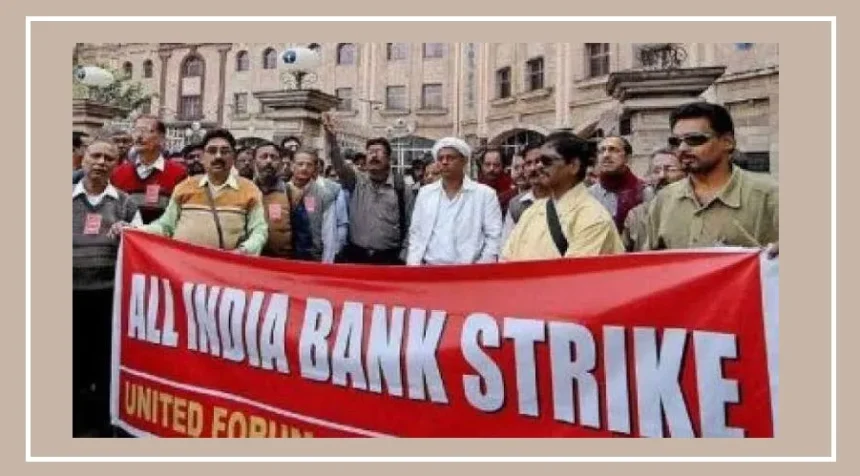
The United Forum of Bank Unions (UFBU) has announced fresh strikes to press the government to approve the proposal. If the demands are not resolved, bank employees have also threatened an indefinite strike from October 26, 2026.
The UFBU has called for an all-India strike on September 11, followed by another three-day strike on September 28, 29 and 30.
The unions are demanding faster implementation of the five-day banking week.
They are also opposing a new performance-linked incentive (PLI) scheme for senior bank officers.
Why Is the 5-Day Bank Week Still Pending?
The proposal for a five-day banking week is not new.
The Indian Banks’ Association (IBA), which represents bank management, and employee and officer unions had already reached an agreement in principle on the proposal.
The arrangement was included in the 12th Bipartite Settlement and 9th Joint Note signed on March 8, 2024.
Under the proposal, banks would operate from Monday to Friday, while Saturdays and Sundays would be weekly holidays.
However, employees would work around 40 additional minutes each day from Monday to Friday to compensate for the working hours currently covered on Saturdays.
The agreement between the IBA and unions, however, is not enough to change the official bank holiday calendar.
A formal notification from the government is still required.
Where Does the Proposal Stand Now?
At present, banks are closed only on the second and fourth Saturdays of every month.
The government had declared these two Saturdays as bank holidays in August 2015 under the Negotiable Instruments Act, 1881.
The IBA has proposed extending this arrangement to all Saturdays.
The government had confirmed in Parliament that the IBA submitted the proposal to declare all Saturdays as bank holidays. However, no final implementation date has been announced so far.
This delay has become a major source of frustration for bank employees and their unions.
What Will Change If Banks Move to a 5-Day Week?
If the proposal is approved, bank branches would operate only from Monday to Friday.
Both Saturday and Sunday would become weekly holidays.
However, this does not necessarily mean employees will work fewer total hours. Under the 2024 agreement, daily working hours from Monday to Friday would increase by about 40 minutes.
For customers, the biggest change would be that branches would remain closed on the first, third and fifth Saturdays, which are currently working days.
However, digital banking services would continue to function.
Customers would still be able to use services such as UPI, internet banking, mobile banking and ATMs even when physical bank branches are closed.
Why Have Bank Unions Announced Fresh Strikes?
The five-day workweek is one of the main demands behind the latest agitation.
The UFBU has demanded an “honourable commitment” from the government to implement the five-day banking system.
The unions have also raised objections to a new performance-linked incentive scheme for senior bank officers.
If the issues remain unresolved, the UFBU has announced an indefinite strike from October 26, 2026.
The issue has already led to nationwide protests and strikes this year. The UFBU had also organised a nationwide strike on January 27, with unions estimating that around eight lakh employees and officers participated.
UFBU Opposes New PLI Scheme for Senior Officers
The five-day banking week is not the only issue creating tension between bank unions and the government.
The UFBU is also opposing a performance-linked incentive (PLI) scheme reportedly introduced for officers in Scale IV and above.

According to the union body, this arrangement is different from the PLI framework agreed between the IBA and unions.
The unions say the earlier framework was intended to provide a more uniform incentive based on the overall performance of the bank and cover employees and officers up to Scale VII.
The UFBU claims that the new government-directed arrangement could provide officers in Scale IV and above with PLI of up to 365 days of basic pay, depending on individual performance.
In comparison, workmen employees and officers up to Scale III could receive a maximum of 15 days of Basic Pay plus DA, according to the union’s circular.
The UFBU has described this difference as discriminatory and says it could create a significant gap in incentives between senior officers and other bank employees.
According to the union, the matter is currently part of conciliation proceedings before the Chief Labour Commissioner and is also being litigated before the Delhi High Court.
What Bank Customers Should Know
For customers, the five-day workweek would mainly mean no physical bank branch operations on Saturdays if the proposal is finally approved.
There is currently no confirmed date for implementation because the required government notification is still pending.
Until an official decision is announced, banks will continue to follow the existing holiday arrangement, including closures on the second and fourth Saturdays.