


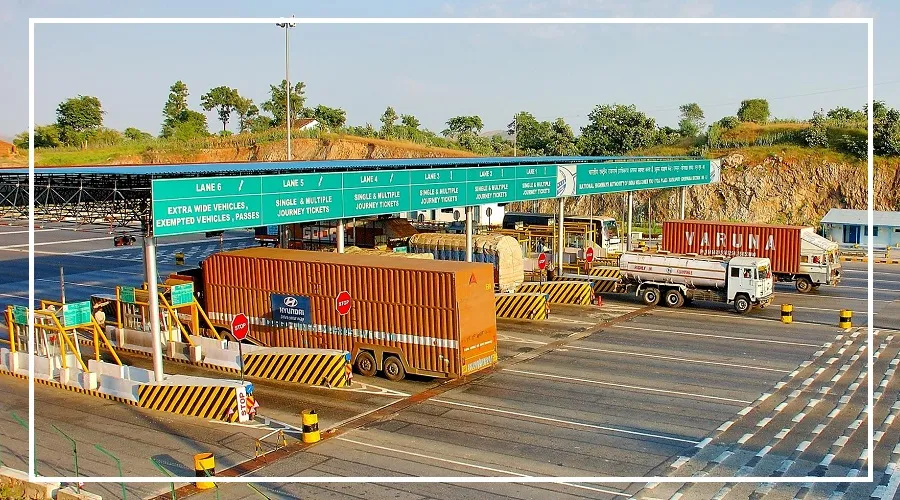
NHAI Barrier-Free Tolling guidelines have been introduced to make travel on four-lane and wider National Highways smoother by allowing vehicles to pass through toll plazas without stopping.
The National Highways Authority of India (NHAI) has standardised the design and infrastructure requirements for the Multi-Lane Free Flow (MLFF) toll collection system.
The new guidelines, announced on November 6, 2026, will apply to upcoming and under-construction National Highway projects.
The initiative aims to reduce long queues at toll plazas, minimise waiting time, lower fuel consumption and improve road safety.
Under the proposed system, vehicles will be able to pass through designated tolling zones while electronic equipment identifies them and facilitates the collection of applicable toll charges.
NHAI Barrier-Free Tolling Guidelines: What Changes?
The new framework establishes uniform standards for toll plaza infrastructure across four-lane and wider National Highways.
NHAI has prescribed requirements covering toll plaza layouts, lane configurations, overhead gantries, road infrastructure, lighting arrangements, signage and supporting facilities.
Unlike conventional toll plazas, where vehicles must slow down or stop at physical barriers to complete toll payments, the MLFF system is designed to collect toll charges without interrupting traffic movement.
The number of lanes required at these toll plazas has also been rationalised because vehicles will no longer need to stop at individual payment booths.
This is expected to improve the utilisation of available space and allow traffic to move more efficiently.
The guidelines also introduce uniform infrastructure requirements so that different National Highway projects can support the same barrier-free tolling technology.
How Will the MLFF Toll Collection System Work?
Multi-Lane Free Flow (MLFF) is a technology-based toll collection system that allows vehicles to travel through designated tolling points without stopping.
The system uses electronic equipment installed on overhead gantries to identify vehicles and process applicable toll payments through electronic toll collection infrastructure, including FASTag.
Unlike traditional toll booths, the barrier-free arrangement does not depend on physical boom barriers that open after a vehicle completes its payment.
The technology is intended to reduce interruptions caused by toll collection, particularly during busy travel periods when conventional toll plazas experience long queues.
NHAI has already started implementing this technology at selected locations. In June 2026, the authority introduced the MLFF system at Gharaunda Toll Plaza on the Panipat-Jalandhar section of National Highway 44.
The latest guidelines are intended to make future highway projects compatible with the wider expansion of barrier-free toll collection.
New Toll Plaza Design, Gantries and Safety Requirements
The guidelines cover several important infrastructure requirements to ensure that barrier-free toll plazas operate efficiently.
Overhead gantries will play an important role in the system by supporting electronic toll collection equipment.
Standardised lane arrangements and gantry positioning are expected to provide consistency across different highway configurations.
The framework also focuses on road safety and visibility. Adequate lighting will be provided in tolling zones, while advance road signage will help motorists identify upcoming toll areas.
Electronic Variable Message Signs (VMS) will also be used to provide relevant information and guidance to highway users.
In addition, the guidelines include provisions for administrative buildings and operations and maintenance centres.
These facilities will support the management, maintenance and day-to-day functioning of toll plaza infrastructure.
The measures are intended to make the transition towards barrier-free tolling more organised while maintaining safety for motorists.
New Rules Apply to Upcoming and Ongoing Highway Projects
The new guidelines will not be restricted to National Highway projects that are yet to begin. They will also cover eligible projects that are already under construction.
Projects currently at the Detailed Project Report (DPR) stage will have to incorporate the revised design requirements into their planning documents.
For projects that have already been awarded or are under construction, the changes will be adopted through applicable contractual provisions.
NHAI has also directed its field offices to include the prescribed infrastructure requirements in upcoming projects and facilitate their implementation in ongoing construction work.
This approach is expected to reduce the need for major modifications when barrier-free toll collection technology is introduced on these highways in the future.

However, the announcement does not mean that every existing operational toll plaza will immediately switch to the new system.
The guidelines primarily establish infrastructure standards for upcoming and ongoing projects.
Will Barrier-Free Tolling Reduce Travel Time and Fuel Costs?
One of the major objectives of the MLFF system is to reduce delays caused by conventional toll collection.
At busy toll plazas, vehicles frequently slow down or stop while waiting for payment processing.
This can result in long queues, additional fuel consumption and delays, particularly during holiday seasons and peak travel hours.
With barrier-free tolling, vehicles will be able to move through designated tolling zones without stopping at physical payment barriers.
Reduced idling and fewer repeated braking and acceleration cycles could also help lower fuel consumption and vehicle emissions around toll plazas.
However, the actual benefits will depend on the effectiveness of the electronic toll collection infrastructure, traffic conditions and proper implementation of the system.
For highway commuters, the new framework represents an important step towards technology-driven toll collection.
As NHAI expands the infrastructure, the long-term objective is to make National Highway journeys faster, safer and more convenient.