

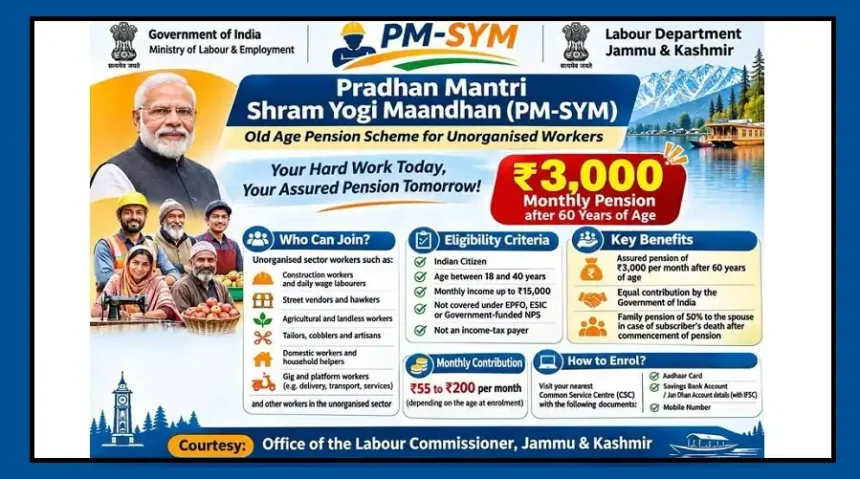
M Shram Yogi Maandhan Scheme provides an opportunity for eligible workers in India’s unorganised sector to receive a guaranteed monthly pension of ₹3,000 after turning 60.
The voluntary pension programme is designed to offer financial support to workers who may not have access to regular retirement benefits.
The scheme covers several categories of workers, including daily wage labourers, street vendors, domestic helpers, construction workers, agricultural labourers, rickshaw drivers and ragpickers.
Eligible workers can join by making a small monthly contribution, with the Central Government contributing an equal amount.
Although the scheme has recently attracted attention, it is not a newly launched programme. The government introduced it in February 2019 to provide old-age financial security to workers in the unorganised sector.
PM Shram Yogi Maandhan Scheme: Who Can Apply?
The pension scheme is primarily intended for workers who depend on daily wages or self-employment and do not have access to formal retirement savings arrangements.
To qualify, applicants must meet the following conditions. Their age should be between 18 and 40 years when joining the scheme, and their monthly income should not exceed ₹15,000.
Applicants must also not be income tax payers. Additionally, they should not be covered under the Employees’ Provident Fund Organisation (EPFO), Employees’ State Insurance Corporation (ESIC) or the National Pension System (NPS) funded by the government.
Workers involved in occupations such as street vending, construction, domestic work, agriculture, weaving, leather work, waste collection and other similar activities can benefit if they meet the eligibility requirements.
How Much Money Must Workers Contribute?
The programme follows a contributory pension model, meaning workers must deposit a fixed amount every month until they reach the age of 60.
The monthly contribution depends on the applicant’s age at the time of registration. Workers who join at a younger age generally need to contribute less than those who enrol later.
For example, an 18-year-old subscriber needs to contribute ₹55 per month. A person joining at 25 years must deposit ₹80 monthly, while someone enrolling at 30 years needs to contribute ₹105.
The contribution increases with the entry age. A worker joining at 35 years must pay ₹150 per month, while those enrolling at 40 years have to contribute ₹200.
The government makes an equal matching contribution for every eligible subscriber. This means that if a worker pays ₹100 per month, the Central Government also contributes ₹100 to that subscriber’s pension account.
The combined monthly contribution is therefore between ₹110 and ₹400, depending on the subscriber’s entry age.
What Pension Will Workers Receive After 60?
After completing 60 years of age, eligible subscribers receive an assured pension of ₹3,000 per month for their lifetime, subject to the scheme’s conditions.
This provides a regular source of income during old age, particularly for workers who may not have substantial savings or other retirement benefits.
The scheme also includes a family pension provision. If a subscriber dies while receiving the pension, the spouse becomes eligible to receive 50% of the subscriber’s pension as a family pension.
This means the eligible spouse can receive ₹1,500 per month under the family pension provision.
The pension benefit is intended to provide financial assistance to the subscriber and some protection to the spouse after the subscriber’s death.
How to Register for the Pension Scheme
Eligible workers can register through their nearest Common Service Centre (CSC). These centres help applicants complete the enrolment process and provide information about the scheme.
Applicants generally need their Aadhaar details and savings bank account or Jan Dhan account information. A mobile number is also useful for registration and communication.
The monthly contribution is linked to the subscriber’s bank account through an automatic debit facility. This allows the prescribed amount to be deducted regularly.
Eligible workers can also visit the official Maandhan portal at maandhan.in to access information about the scheme and available enrolment facilities.
Before registering, applicants should check their eligibility, entry-age requirements and applicable monthly contribution.
Why This Pension Scheme Matters for Unorganised Workers
Many workers in the unorganised sector depend on their physical ability to earn a living. As they grow older, continuing the same work can become difficult, potentially affecting their regular income.
Unlike employees covered by formal retirement arrangements, many self-employed and daily wage workers do not have access to employer-supported pension benefits.
The PM-SYM programme attempts to address this gap through shared contributions from subscribers and the government.
According to government information released in August 2026, more than 54 lakh beneficiaries had enrolled in the scheme across the country as of July 29, 2026. Women accounted for 53.1% of enrolled unorganised workers.
The programme therefore offers an organised pension option for eligible workers who want to build a basic source of retirement income through regular contributions.