
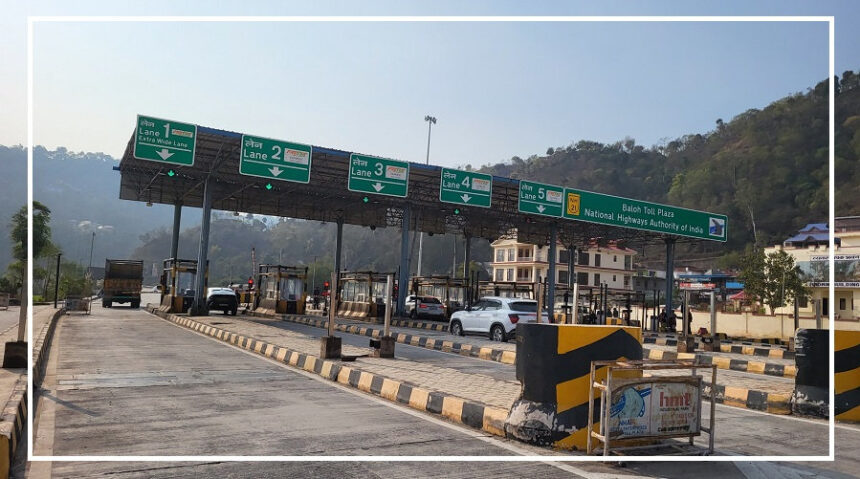
The National Highways Authority of India (NHAI) has introduced a new toll calculation system that could reduce charges for vehicles travelling on highways with bridges, tunnels, flyovers and elevated roads.
The revised formula places a limit on the distance used for toll calculation, which means commuters may no longer have to pay higher charges on highway sections with expensive infrastructure.
The change has been introduced after amendments to the National Highways Fee Rules and is expected to benefit both private vehicle owners and commercial transport operators.
New Toll Formula Limits Chargeable Distance
Earlier, toll charges on highways with major structures were calculated by giving extra weight to the length of bridges, tunnels and elevated roads.
Under the old system, the length of these structures was multiplied by 10 times because of their higher construction and maintenance costs.
However, the new rule introduces a cap.
Now, the tollable distance will be calculated using whichever is lower:
10 times the length of bridges, tunnels, flyovers and elevated roads, plus the remaining normal road length, or
Five times the total length of the entire highway section
This change will reduce toll charges on routes where a large part of the highway consists of elevated structures or tunnels.
Example: How the New Rule Reduces Toll Charges
Suppose a 40-km highway has:
30 km of bridges and elevated structures
10 km of regular road
Under the old calculation:
30 km × 10 + 10 km = 310 km tollable distance
Under the new calculation:
40 km × 5 = 200 km tollable distance
Since 200 km is lower than 310 km, the toll will now be calculated on 200 km, reducing the amount paid by motorists.
Similarly, if a 40-km highway has only 10 km of structures and 30 km of normal road, the tollable distance will become 130 km, which is again lower than the 200-km limit.
Small Bridges and Structures Won’t Increase Toll
The revised rules also provide relief from small infrastructure charges.
Bridges, tunnels, flyovers or elevated sections measuring 60 metres or less will not be considered separate structures for toll calculation.
This will prevent minor structures from unnecessarily increasing toll costs for commuters.
When Will the New Toll Rules Apply?
The implementation timeline will depend on the type of toll plaza.
For government-operated toll plazas, the new formula will be applied during the next scheduled toll revision.
For highways managed by private concessionaires, the revised system will come into effect after the concession period ends or when the highway is transferred back to NHAI.
Newly opened toll plazas will follow the new formula from the start of toll collection.
A Relief for Regular Highway Travellers
The revised toll calculation system is expected to make travel more affordable on highways with large bridges, tunnels and elevated corridors.
By limiting the distance used for toll calculations, NHAI aims to create a fairer and more transparent toll system while continuing to support the development and maintenance of modern highway infrastructure.